Data Integration

Connect Industrial and Business Data into Tier0

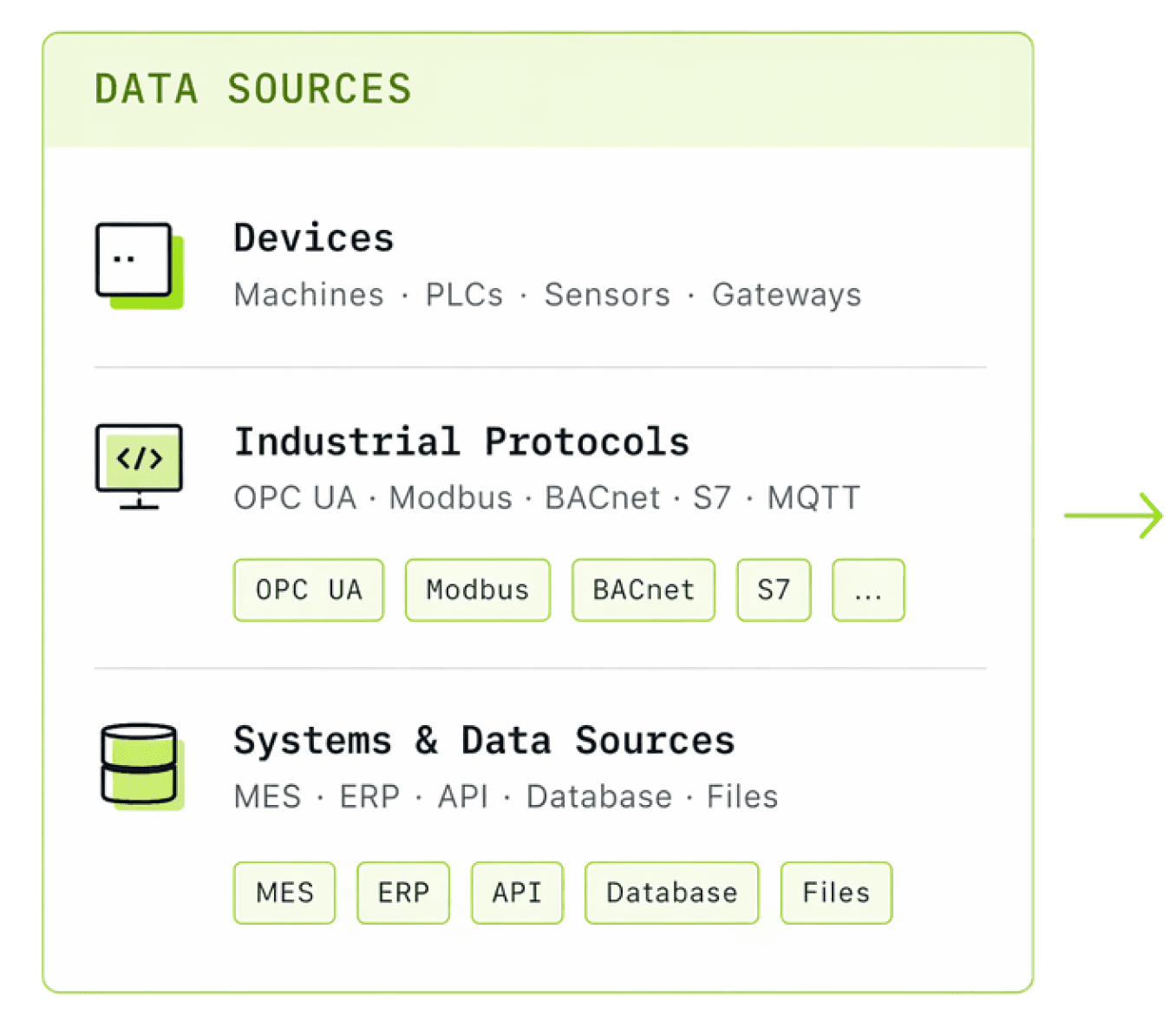
Bring data from machines, PLCs, plant systems, enterprise applications, APIs, and databases into Tier0 through flexible data flows.Transform, route, and standardize data in real time for applications, analytics, alerts, and AI.

Data collection is the starting point of a reusable industrial data foundation. Instead of building one-off interfaces for every new requirement, Tier0 helps teams connect data once, structure it properly, and reuse it across the platform.

DATA FLOWS

DATA FLOWS

Overview

What is Data Collection in Tier0

What is Data Collection in Tier0

Data Collection in Tier0 is the capability for connecting fragmented data sources and bringing them into a shared, reusable data foundation.

It supports both OT and IT data, including machine signals, system transactions, API data, and database records. Incoming data can be collected, transformed, filtered, mapped, and routed before being published into Tier0 for broader reuse.

A flow-based integration approach is used underneath to make connectivity flexible and maintainable, with Node-RED supporting implementation where appropriate.

OT + IT Connectivity

Connect both OT and IT data sources.

Real-Time Data Flows

Collect, transform, and route data as it happens.

Reusable Data Foundation

Structure data once and reuse it across the platform.

Connectivity

Supports Common Industrial Protocols

and System Interfaces

Tier0 supports common industrial connectivity scenarios across standard protocols, controller ecosystems, and system interfaces. It is designed to collect not only device data, but also plant and enterprise data within the same architecture.

Standard Industrial Protocols

OPC UA, MQTT, and Modbus for common industrial data exchange and edge connectivity.

PLC and Controller Protocols

Siemens S7, EtherNet/IP, Omron FINS, Mitsubishi communication protocols, and Beckhoff ADS.

Building and Facility Protocols

BACnet and related building-side protocols for facility and warehouse connectivity.

File, API, and Database Interfaces

REST APIs, web services, databases, CSV files, batch uploads, and scheduled extracts.

Extensible Connectivity Model

Reusable connectors and flow-based nodes can be added for project-specific protocols, devices, and interfaces.

Implementation

How Data Collection Is Built

How Data
Collection Is Built

Data collection is configured through flow-based logic rather than heavy custom integration each time. Engineers assemble flows by connecting reusable nodes for input, transformation, routing, and publishing.

01

Drag in source nodes

01 Drag in source nodes

Add nodes for protocols, systems, APIs, or

databases into the workspace to define

where data comes from.

02

Connect and transform

02 Connect and transform

Wire nodes together to filter payloads,

map fields, normalize formats, enrich

context, and apply rules.

03

Route and publish

03 Route and publish

Send processed data to Tier0 topics,

dashboards, alerts, downstream systems,

or applications based on logic.

04

Deploy and reuse

04 Deploy and reuse

Deploy the flow and reuse the same

pattern across multiple lines, sites, or

applications with much less repeated

engineering work.

Flow-based implementation enables faster configuration and easier maintenance than one-off custom interface development.

Flow-based implementation enables faster configuration and easier maintenance than

one-off custom interface development.

Data Types

What Tier0 Can Collect

Category

Examples

Edge and Device Data

Machine states, counters, PLC tags, process values,

sensor readings, device telemetry, gateway payloads

Operational Application Data

Work orders, production records, quality results,

inventory movements, warehouse events

Enterprise & Business Data

ERP master data, order data, shipment records,

API responses, business transactions

Files and Structured Data

CSV files, database tables, batch uploads, scheduled

extracts

Category

Examples

Edge and Device Data

Machine states, counters, PLC tags, process values, sensor readings, device telemetry, gateway payloads

Operational Application Data

Work orders, production records, quality results, inventory movements, warehouse events

Enterprise & Business Data

ERP master data, order data, shipment records, API responses, business transactions

Files and Structured Data

CSV files, database tables, batch uploads, scheduled extracts

Architecture

How Data Collection Works with Tier0

How Data Collection Works with Tier0

1

Data Collection

Data Collection brings data into Tier0.

2

UNS

UNS structures that data into a shared operational model.

3

Application

Applications use that structured data to support workflows and execution.

4

Analytics & AI

Analytics and AI build on the same foundation for insight, prediction, and optimization.

1

Data Collection

Data Collection brings data into Tier0.

2

UNS

UNS structures that data into a shared operational model.

3

Application

Applications use that structured data to support workflows and execution.

4

Analytics & AI

Analytics and AI build on the same foundation for insight, prediction, and optimization.

This is how Tier0 turns fragmented data connectivity into reusable business value.

FAQ

Frequently Asked Questions

Frequently Asked Questions

What industrial protocols does Tier0 support?

What kinds of devices and systems can Tier0 collect from?

Can data be transformed before it is published?

Does it support real-time data flows?

Is this only for OT data?

How is data collection different from UNS?

How is data collection configured?

Can the same data flow be reused across projects?

Is coding required?

Next Steps

Start from a working app, not from scratch

Deploy industrial applications faster by reusing proven apps built on a shared data foundation.

Next Steps

Start from a working app, not from scratch

Deploy industrial applications faster by reusing proven apps built on a shared data foundation.

STAY UP TO DATE WITH PRODUCT UPDATES, LEARNING RESOURCES, AND MORE.

Singapore · Hangzhou China

About FREEZONEX

© 2026 FREEZONEX • All Rights Reserved

STAY UP TO DATE WITH PRODUCT UPDATES, LEARNING RESOURCES, AND MORE.

Singapore · Hangzhou China

About FREEZONEX

© 2026 FREEZONEX • All Rights Reserved