Unified Namespace
What is Unified Namesapce?
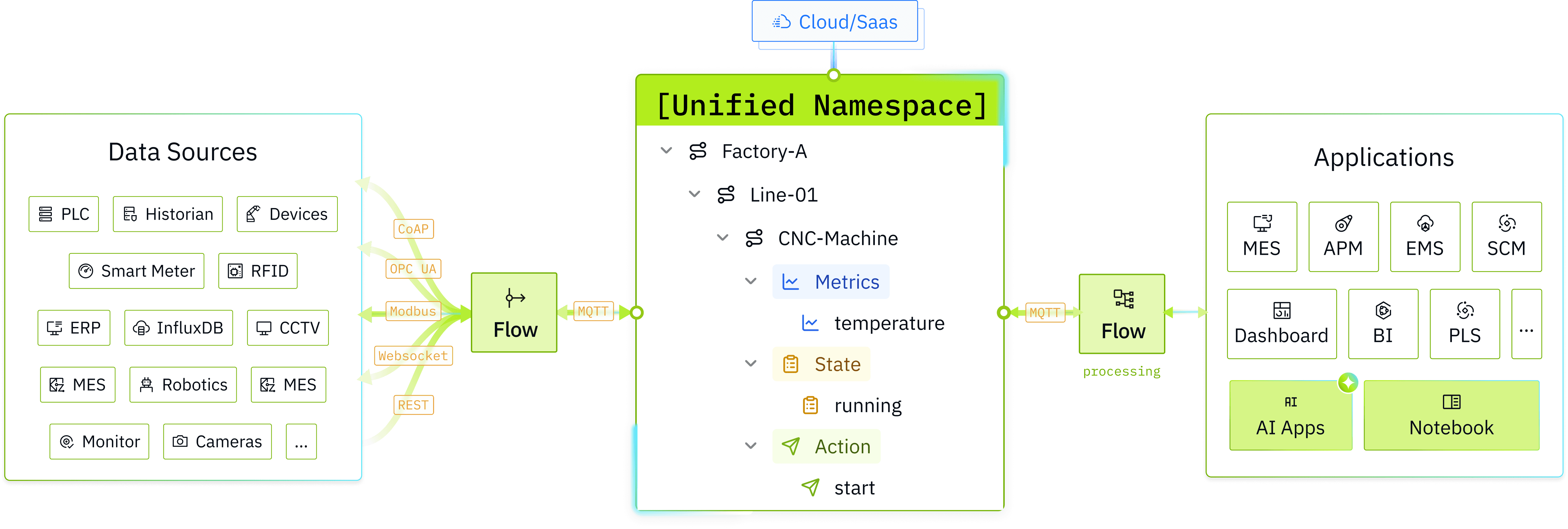
Tier0 implements Unified Namespace as a practical industrial data architecture. Built on MQTT-based pub/sub, it connects machines, systems, and applications into one structured namespace where data is organized by semantic context, reused across use cases, and continuously extended by the applications built on top of it.
Concept
What Unified Namespace
means in Tier0
A Unified Namespace is often described as a way to organize industrial data in one shared space. In Tier0, it is more specific than that.
It is a real-time, structured operational namespace built on top of MQTT-based publish/subscribe. Data from different producers is published into one shared system, then organized according to how operations actually work — not simply according to which source system the data came from.
That means the namespace is not just a stream of messages. It is a model of industrial operations. It can represent sites, areas, lines, equipment, processes, materials, orders, states, events, and other business-relevant objects in one connected structure.
This is what makes the data usable beyond integration. It gives the platform a common operational language that applications, workflows, dashboards, and analytics can all build on.
Not just connected data. Semantic, operational, reusable data.
Protocol
Why MQTT matters
Tier0 uses MQTT as the real-time backbone of its Unified Namespace architecture. MQTT is well suited to industrial environments because it is lightweight, event-driven, and naturally supports publish/subscribe communication.
Producers can publish updates as they happen, and consumers can subscribe to the data they need without direct dependency on the original source. This matters because industrial data is constantly changing. Machine states shift, process values update continuously, and events unfold in real time.
In Tier0, MQTT is the mechanism that keeps the namespace live. It allows industrial systems, enterprise applications, and Tier0-native apps to exchange data continuously through one shared architecture instead of through brittle one-off interfaces.

Architecture
Why publish/subscribe changes the architecture
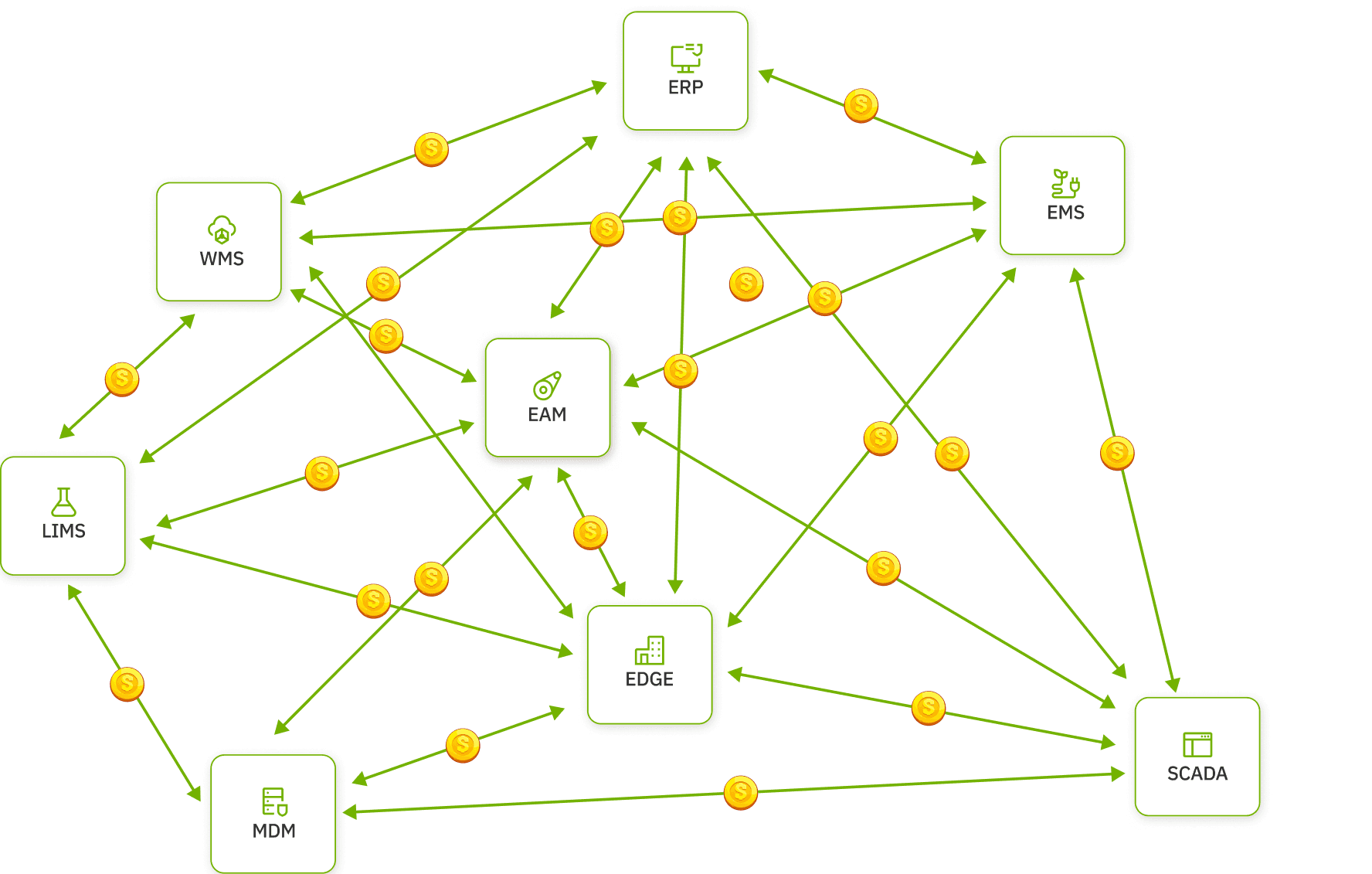
Traditional integration usually connects systems one by one. One source sends data to one target, then another interface is added for another target, and another after that. Over time, the architecture becomes harder to understand, harder to maintain, and harder to scale.
Tier0 changes this with publish/subscribe. Instead of every consumer connecting directly to every producer, data producers publish into a shared namespace. Consumers subscribe to the data they need from that namespace. This decouples producers from consumers.
A PLC does not need to know which dashboard, workflow, app, or analytics tool will use its data. It just publishes to the namespace. A workflow engine, dashboard, notebook, or application can then subscribe independently.
That shift is important. It reduces interface coupling, simplifies extension, and allows the same real-time data to be used by many downstream consumers without rebuilding the architecture every time.
Structure
Why the namespace matters
beyond messaging
MQTT alone is not enough. A message bus can move data, but moving data is not the same as structuring it. If messages remain isolated, named inconsistently, or understood only by the teams that created them, the result is still hard to reuse.
Tier0 solves this by organizing messages into a structured namespace based on operational context. Instead of thinking in terms of "data from MES" or "data from ERP," Tier0 structures data around operational entities such as site, area, line, equipment, process, material, order, state, and event.
That structure is what turns message flow into an industrial data foundation. A machine state is no longer just a message. It becomes the current state of a specific machine on a specific line in a specific site. A workflow event is no longer just an application log. It becomes part of the operational history of a process, order, or asset.
This is the layer that makes data understandable, governable, and reusable.

Reuse
How reuse actually works
In many industrial projects, "reuse" sounds good in theory but disappears in practice. Teams still end up rebuilding interfaces, remapping data, and reinterpreting context every time they deliver a new use case.
Tier0 approaches reuse differently. Reuse happens because data is published once into a shared namespace and then consumed by multiple downstream use cases from the same structure. The reuse is not manual. It is architectural.
A machine state published into Tier0 can be subscribed by:
Real-time dashboard
Alerting workflow
Operator-facing application
Analytics notebook
Reporting service
Downstream system
This is what changes the economics of delivery. Once the namespace is in place, new apps and workflows can be built on top of existing operational context instead of starting from raw integration work again.
The value of Unified Namespace is not just connectivity. It is reusable context.
Data Model
What can be modeled in the namespace
Tier0's namespace is designed to reflect industrial operations as a whole, not just machine telemetry. It can model the physical layer, the process layer, and the business layer in one connected structure.
This is why Tier0's UNS is not just for moving OT data.
It is built to represent industrial operations in a form that software can actually use.
Feedback Loop
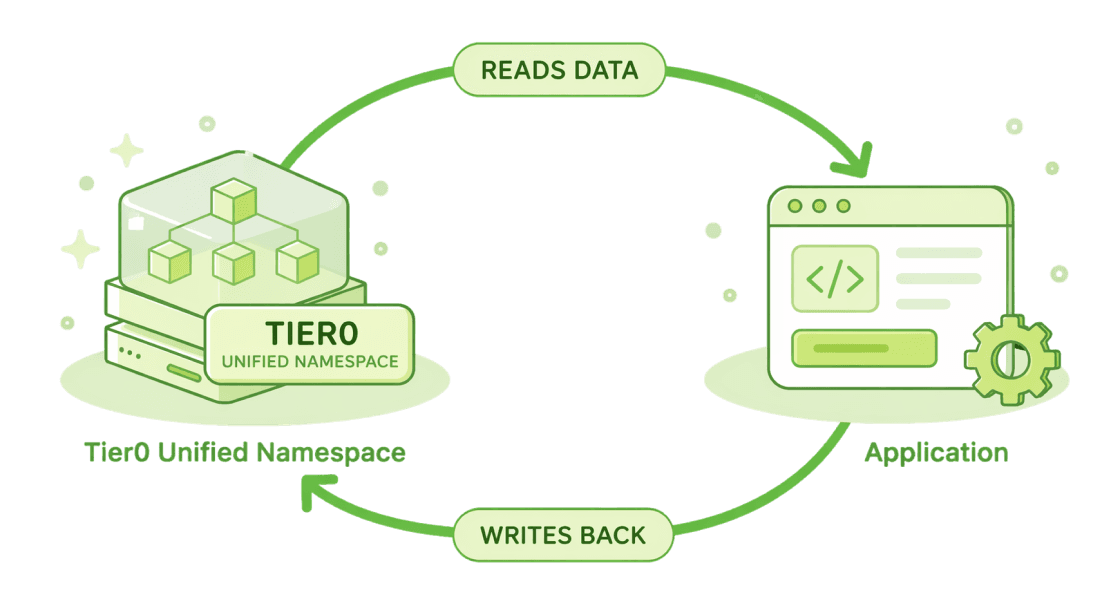
Applications do not just consume data — they write back
A lot of architectures treat applications as endpoints. They read data, display it, maybe store something locally, and stop there. Tier0 is different.
Applications built on Tier0 are also able to publish operational data back into the same namespace. That includes records generated by workflows, user actions, approvals, form submissions, task updates, inspection results, process events, and other operational outcomes.
The namespace is not just a read layer for upstream industrial systems. It is also a write layer for downstream operational software. That means applications do not become new silos. They contribute back to the same shared system.
Source systems publish data
Tier0 structures it
Applications use it
Applications publish new data back
Namespace becomes more valuable
Data Model
Because Tier0 combines MQTT-based pub/sub with a structured operational namespace, the same data foundation can support many different outcomes across the platform.
This is where the architecture starts compounding in value.
Each additional use case benefits from what is already there.
Comparison
More than connectivity
Tier0 does more than move data between systems. Traditional integration tools are often good at transport. They connect one thing to another, move messages, and help bridge protocols. But transport alone does not create a reusable operational model.
Tier0 uses Unified Namespace plus MQTT-based pub/sub to solve a broader problem. It creates a shared industrial context that the rest of the platform can build on directly.
The difference is not just how data moves. It is how data is organized for long-term reuse.
