How a Unified Namespace Changes the Cost of Every Use Case

UNS

5 minutes

Ask around a factory what digitalization should deliver and you will rarely get one answer. Production wants status and exception management. Quality wants traceability. Maintenance wants equipment history. Management wants analysis that connects all three.

The usual response is a series of projects. Each has its own scope, application and budget. When they are delivered as isolated point-to-point solutions, each may also pay again for access to data the factory has already connected once.

A Unified Namespace (UNS) changes that pattern by publishing governed operational context once so it can be reused by applications, analytics and agents.

The important claim is not that the first Tier0 project removes discovery or data-integration work. It is that the same work should not have to be repeated for every new consumer.

The first connection still requires real engineering

Every industrial project must understand the process, identify data sources, agree on definitions, connect systems, and validate data quality. Tier0 should not claim that these steps are automatically faster. A capable conventional delivery team may complete discovery or initial integration just as efficiently.

The complexity is determined by the factory: PLC and SCADA structures, MES and ERP interfaces, databases, OPC UA endpoints, naming quality and ownership. Tier0’s first-project advantage begins later. App Builder reduces custom application engineering, while permissions, managed data, deployment, web and mobile access, and version updates are already part of the platform.

The more important difference is what happens to the data after that first application goes live.

Why a Unified Namespace makes data reusable

A connection alone does not create reuse. Raw tags and messages must be organized into an operational context that another application can understand.

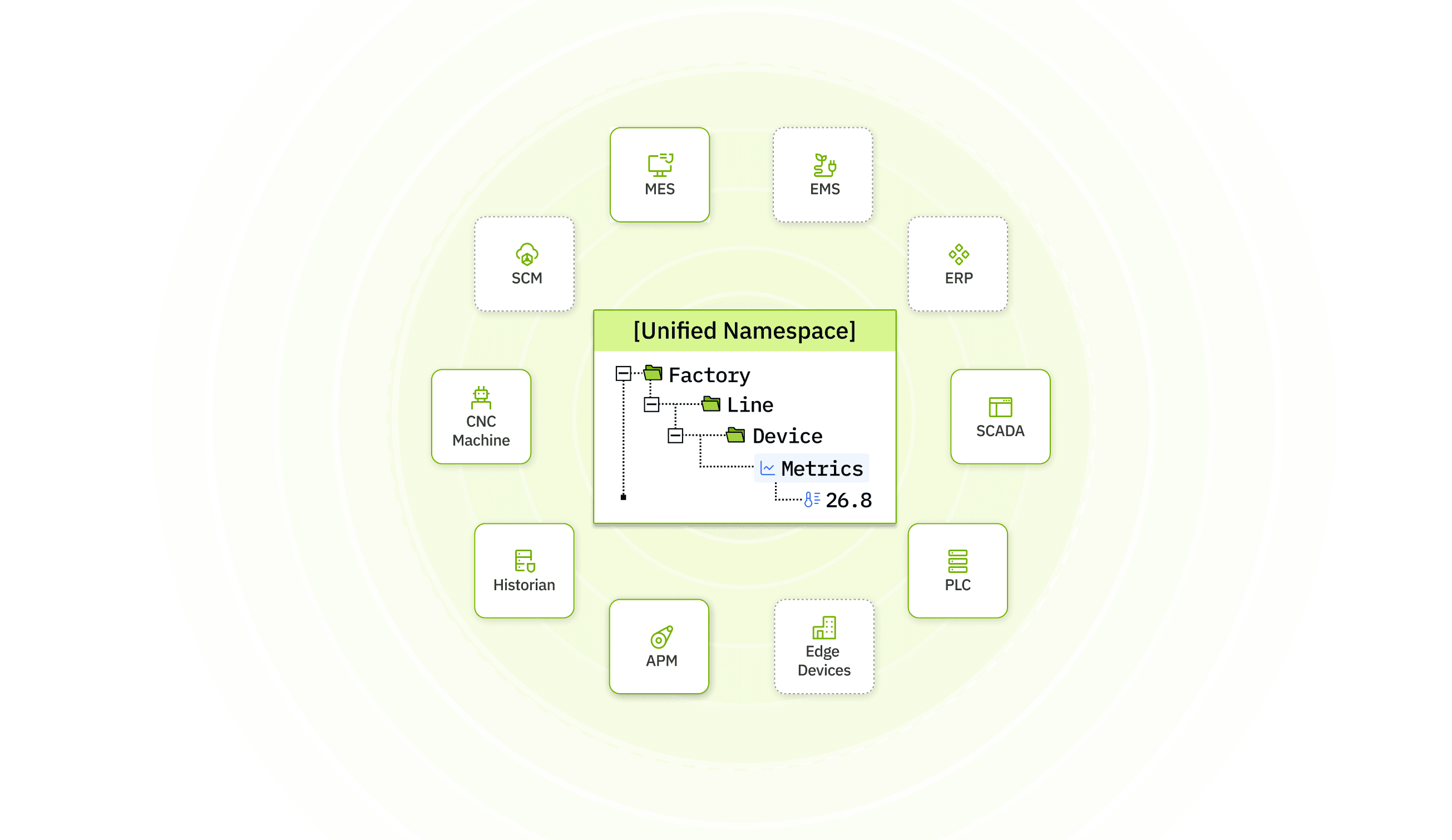
Tier0 connects data from sources such as OPC UA, databases and APIs, then publishes it through an MQTT-based Unified Namespace. The Namespace organizes information around sites, lines, equipment, orders, products, batches, states and events. An application subscribes to this governed context instead of building a new point-to-point interface back to every source system.
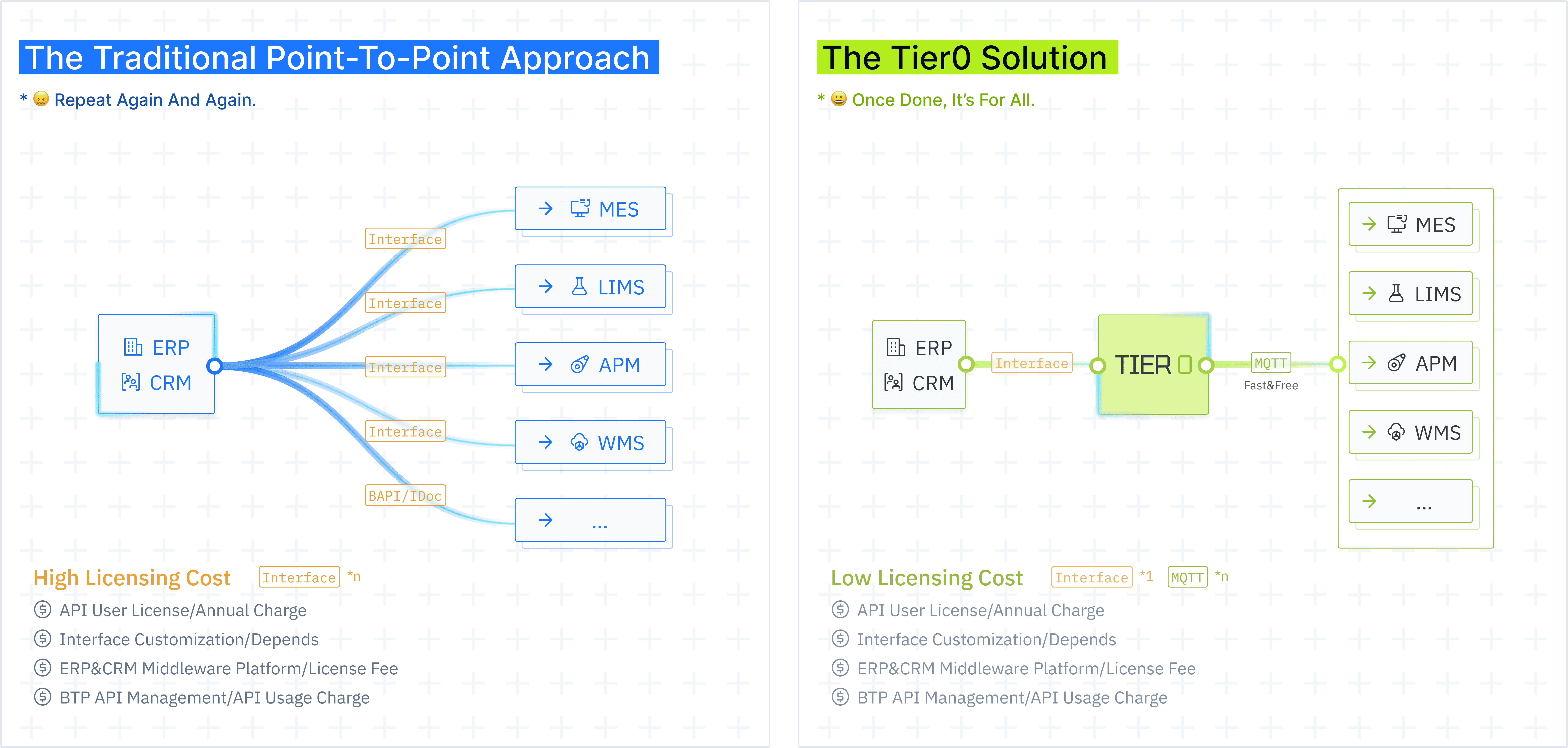
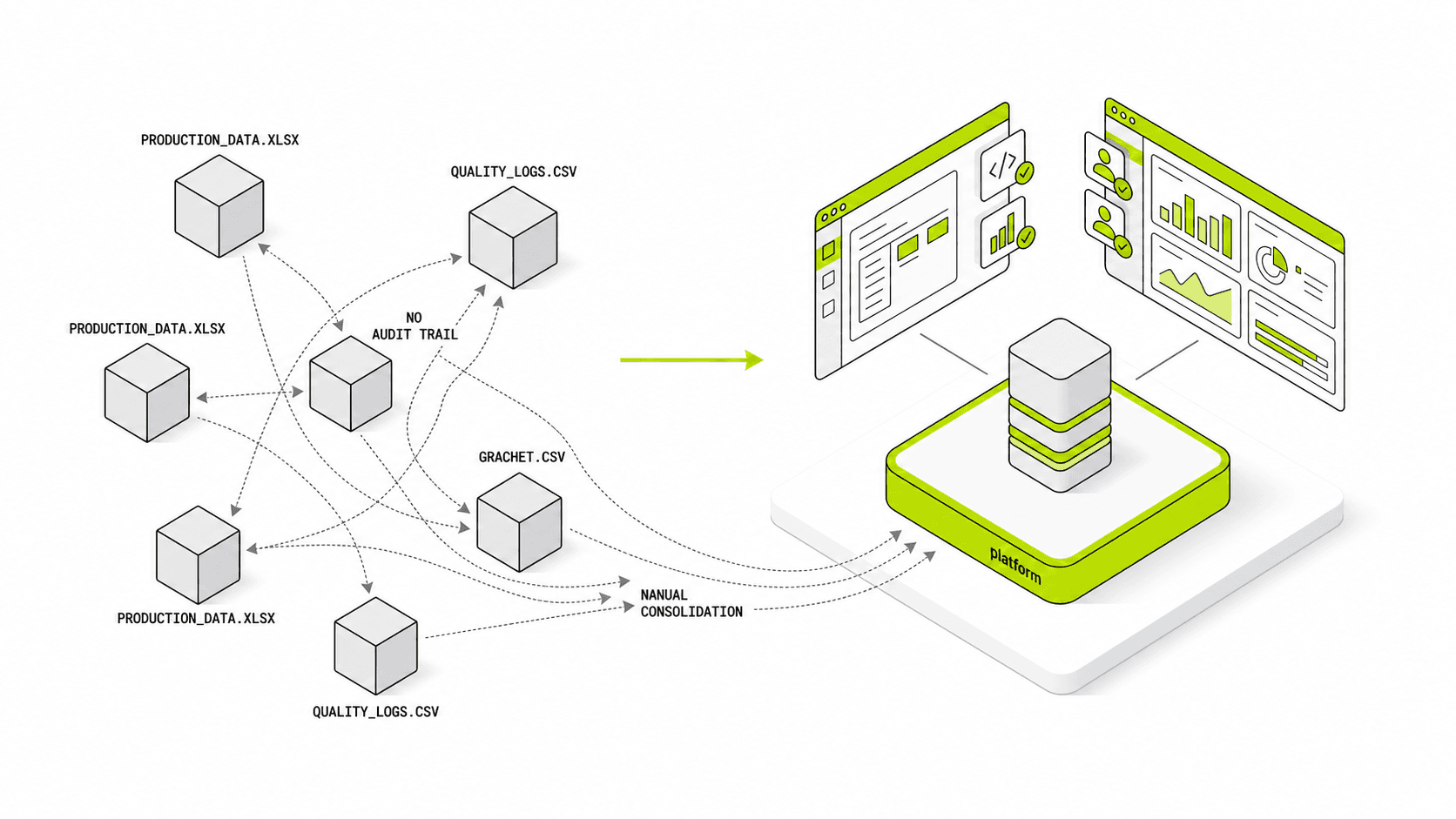
Figure 1. Point-to-point applications create consumer-specific mappings; a UNS publishes contextualized operational data for reuse.

When a quality application needs the same equipment state already used by production, it can consume the existing Namespace object. When an Agent investigates downtime, it can use the same equipment, order and event relationships. New data domains still require integration and governance; existing domains do not need to be rebuilt merely because there is a new consumer.

Could a strong data team build this with Kafka or MQTT?

Yes. A well-designed Kafka, MQTT or enterprise data architecture can support reuse. A strong architecture team can create common schemas, governance and APIs without Tier0.

The difference is not whether reuse is technically possible. It is how much of a platform the customer must design, assemble and maintain. A broker transports messages; it does not by itself define industrial objects, govern their relationships, generate operational applications, provide an application lifecycle, or connect the same context to analytics and agents.

In many centrally managed architectures, a new consumer still depends on the data team to create or modify mappings and interfaces. With a governed UNS, an authorized application can subscribe to an existing operational model. This reduces consumer-specific integration queues without pretending that data governance disappears.

The economic difference appears since the first use case

Consider four use cases in one factory: production management, quality traceability, maintenance analysis and energy analysis. They need different combinations of the same equipment, state, order, batch and event data.
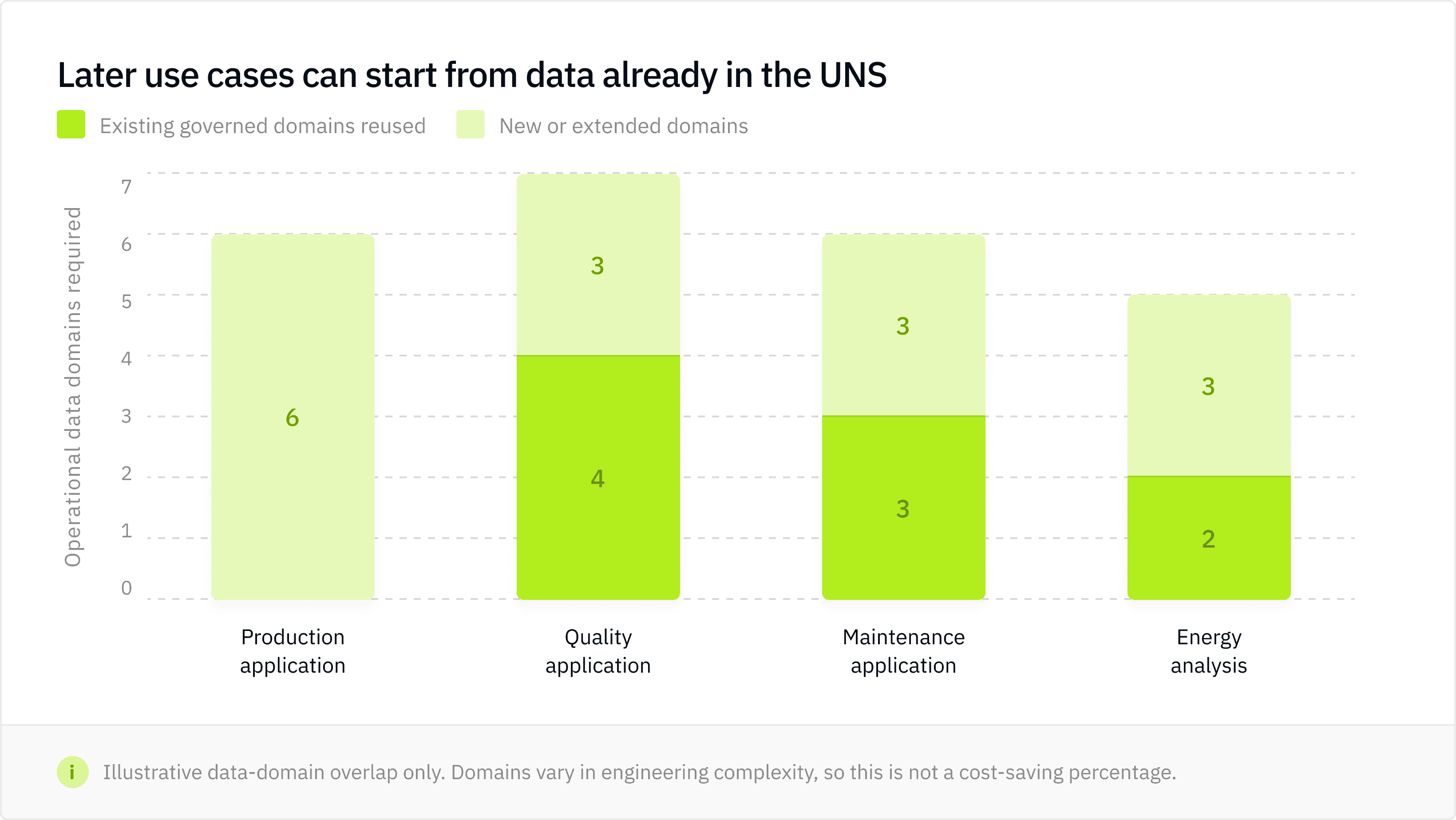
Figure 2. Illustrative domain overlap. The chart counts reused versus new domains; it does not equate a domain with a fixed cost.

This model deliberately avoids producing a headline saving percentage. One data domain may require a simple mapping; another may require weeks of validation. The chart proves only that later use cases can begin with existing governed context rather than starting every data conversation from zero.

The customer-specific economic effect depends on the number of planned use cases, their data overlap, the effort required to onboard each new domain, and the application work avoided through Builder and the managed release lifecycle.
A worked example: four applications, three delivery models

The following scenario demonstrates the calculation. It is not a Tier0 quote, benchmark or guaranteed result. Replace every input with the customer’s actual scope, rates and validated business baseline.

  • Four applications: production exceptions, quality traceability, maintenance analysis and energy analysis

  • Supplier or FDE labor: $900 per day; customer internal labor: $450 per day

  • Traditional delivery: 283 days; Tier0 delivery: 173 days

  • Annual operational benefit after all four applications are live: $270,000

  • Tier0 subscription: $20,000 per year, including platform operations and technical support

  • FDE maintenance: 10% of the FDE engineering total per year

Illustrative cost

Traditional delivery

Tier0 FDE

Tier0 self-delivery

One-time economic investment

$254,700

$155,700

$77,850

External engineering fees

$254,700

$155,700

$0

Customer internal labor

Not separated

Not separated

$77,850

Annual subscription

$20,000

$20,000

Annual engineering maintenance

$25,470*

$15,570

$0

Annual recurring cost

$25,470

$35,570

$20,000

*The traditional maintenance figure uses the same illustrative 10% assumption for a neutral comparison. Actual contracts vary.

Self-delivery is not free. All 173 customer delivery days are valued at $450 per day. The customer performs requirements work, data integration, UNS configuration, application building and validation. Tier0 charges no additional application-development fee, and there is no FDE maintenance fee because no FDE engineering was purchased.

Calculating simple payback

Simple payback period (years) = One-time economic investment ÷ Annual net benefit

Annual net benefit = Annual operational benefit − Annual recurring cost


Result

Traditional delivery

Tier0 FDE

Tier0 self-delivery

Annual operational benefit

$270,000

$270,000

$270,000

Initiative Investment

$254,700

$155,700

$77,850

Annual recurring cost

$25,470

$35,570

$20,000

Annual net benefit

$244,530

$234,430

$250,000

Simple payback

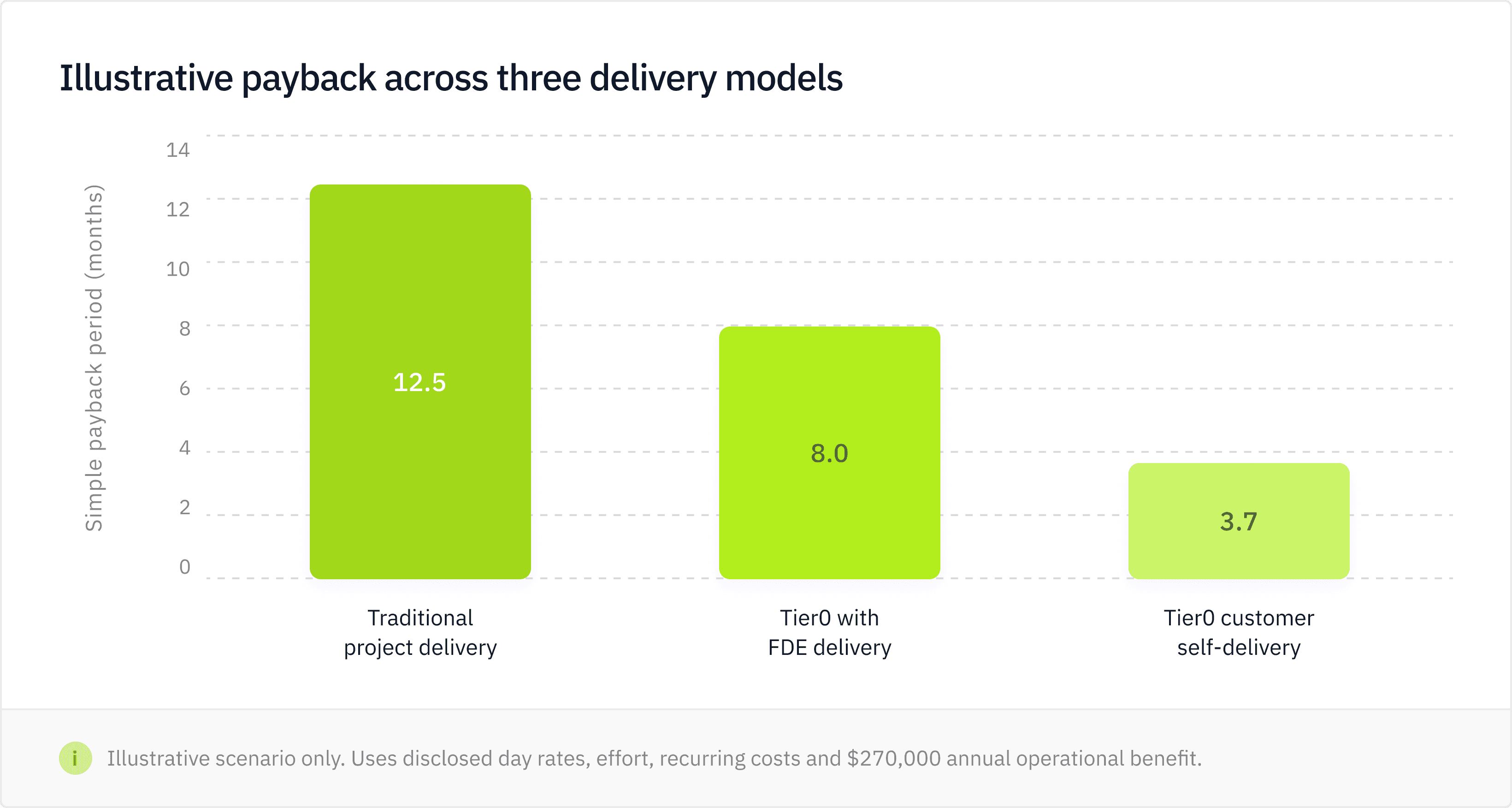
12.5 months

8.0 months

3.7 months


Figure 3. Worked-example payback. The result changes when any input changes; it is not a promised Tier0 outcome.

The model does not assume that Tier0 makes initial discovery or the first data connection faster. The difference comes from less repeated data work, a productized application lifecycle, and—under self-delivery—the customer’s lower internal labor cost. If applications go live at different times, use monthly cash flow rather than assuming that all $270,000 begins on day one.

UNS Agent creates value beyond the four applications

The base $270,000 benefit deliberately excludes UNS Agent. Once equipment, orders, batches, states and events share governed context, teams can investigate questions that were never designed into the original applications: which conditions preceded a quality loss, which equipment states were common before the longest downtime events, or how production and energy behavior changed together.

This is option value. Future investigations, analyses and AI-assisted workflows can begin from existing context instead of another integration project. Do not add an arbitrary amount to the base ROI. Measure it after deployment through investigation hours avoided, ad hoc reports not developed, response time and the number of teams reusing the same data foundation.

Ask what the project leaves behind

For one independent workflow, Tier0 Builder may be enough. For a continuing pipeline of applications, analytics and AI, Tier0 Platform turns connected industrial data into reusable operational infrastructure.

That suggests a better question for an industrial digitalization business case: not only ‘What does this project return?’ but also ‘What does this project leave behind for the next one?’ A working application creates immediate value. Reusable operational context changes the cost and speed of what follows.

Map the applications planned for the next 12–24 months, identify their genuinely shared data domains, and ask Tier0 to model reuse against your actual integration baseline.

Recent blogs

  • Product

    Tier0 vs MQTT Brokers (EMQX, HiveMQ): Why a Broker Is Necessary But Not Sufficient

    May 26, 2026

    Product

    Tier0 vs Ignition: Two Paradigms - SCADA Engineering vs UNS + Natural-Language Generation

    May 25, 2026

    Product

    Tier0 vs United Manufacturing Hub: Open-Source Infrastructure or Productized UNS Application Delivery?

    May 22, 2026

    Product

    Tier0 vs HighByte: Industrial DataOps Component or Full-Stack UNS Platform with AI-Generated Apps?

    May 21, 2026

    UNS

    The Full-Stack UNS Platform: From Data Foundation to UNS-Native Applications

    May 20, 2026

    Partner

    Tier0 × EMQX: Building a Real-Time Data Foundation for Industrial AI

    May 19, 2026

    UNS

    What is Unified Namespace (UNS)?

    May 6, 2026

    Product

    What is an Industrial App Platform?

    May 7, 2026

    Use Cases

    What is Lightweight Digitalization?

    May 8, 2026

    Use Cases

    From Excel to System: What Changes?

    May 7, 2026

    Use Cases

    What is Shopfloor Digitalization?

    May 7, 2026

    AI

    Reinventing Industrial Software

    Apr 18, 2026

    UNS

    UNS – The Sole Key to Industrial Digitalization

    Oct 10, 2024

    AI

    Lightweight Multimodal Models for Edge-Based Defect Detection

    Sep 23, 2024

    AI

    Discrete-Event Simulation + Reinforcement Learning

    Sep 9, 2024

    Integration

    MING & Modern IIoT

    Aug 21, 2024

    UNS

    Revolutionize Industrial Data Integration: The UNS Approach

    Feb 7, 2024

  • Product

    Tier0 vs MQTT Brokers (EMQX, HiveMQ): Why a Broker Is Necessary But Not Sufficient

    May 26, 2026

    Product

    Tier0 vs Ignition: Two Paradigms - SCADA Engineering vs UNS + Natural-Language Generation

    May 25, 2026

    Product

    Tier0 vs United Manufacturing Hub: Open-Source Infrastructure or Productized UNS Application Delivery?

    May 22, 2026

    Product

    Tier0 vs HighByte: Industrial DataOps Component or Full-Stack UNS Platform with AI-Generated Apps?

    May 21, 2026

    UNS

    The Full-Stack UNS Platform: From Data Foundation to UNS-Native Applications

    May 20, 2026

    Partner

    Tier0 × EMQX: Building a Real-Time Data Foundation for Industrial AI

    May 19, 2026

    UNS

    What is Unified Namespace (UNS)?

    May 6, 2026

    Product

    What is an Industrial App Platform?

    May 7, 2026

    Use Cases

    What is Lightweight Digitalization?

    May 8, 2026

    Use Cases

    From Excel to System: What Changes?

    May 7, 2026

    Use Cases

    What is Shopfloor Digitalization?

    May 7, 2026

    AI

    Reinventing Industrial Software

    Apr 18, 2026

    UNS

    UNS – The Sole Key to Industrial Digitalization

    Oct 10, 2024

    AI

    Lightweight Multimodal Models for Edge-Based Defect Detection

    Sep 23, 2024

    AI

    Discrete-Event Simulation + Reinforcement Learning

    Sep 9, 2024

    Integration

    MING & Modern IIoT

    Aug 21, 2024

    UNS

    Revolutionize Industrial Data Integration: The UNS Approach

    Feb 7, 2024